













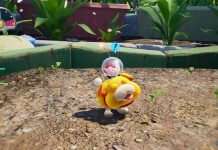
















If there is one thing Nintendo knows how to do perfectly, it’s creating worlds that make you smile—worlds with that “magical” ability to transport you back to childhood, to a time when you were still innocent and the spark in your eyes glowed with every new digital adventure. In 2023, Nintendo released Pikmin 4 for the Nintendo Switch. As the number in the title suggests, this is the fourth main installment in the series, inviting players of all ages to get lost in a colorful yet challenging world where exploration, strategy, and environmental puzzle-solving create a unique space-rescue adventure.
Our story begins when the spaceship of the Rescue Corps, a team that takes on missions across the galaxy, receives a distress signal from Captain Olimar. The mission seems simple enough at first, but things don’t go as planned. The crew ends up making an emergency landing on an unknown planet, and its members are scattered across the surface. That’s where we come in, creating our own character and embarking on a rescue mission to locate the missing crew and find a way for everyone to return safely to base.

Along the way, however, we discover that we aren’t alone in this strange world. Tiny, plant-like creatures with unique abilities—the Pikmin—become our invaluable allies, while meeting Oatchi, an adorable space dog, proves equally decisive for the journey. The planet we traverse is a truly wonderful microcosm, full of color and surprises. Nintendo masterfully utilizes the concept of scale, turning familiar environments into massive areas of exploration. A garden, a beach, or even the inside of a house take on a completely different dimension, as a simple everyday object can become a significant obstacle or a precious treasure for our team.
Top gaming, tech & entertainment news. No spam.
In terms of narrative, I wouldn’t say the story is the primary reason to play Pikmin 4. The plot serves more as a framework, giving us a reason to explore the planet and search for the rest of the team. After all, the real interest lies in the small discoveries made during exploration.

Where Pikmin 4 truly shines is in its gameplay and the way it leverages the different abilities of our small companions. Each type of Pikmin has its own properties, and choosing the right one is a core part of exploration. For example, Ice Pikmin can freeze water surfaces, allowing us to cross, while red Pikmin, who are fire-resistant, help us overcome flaming traps. I still remember the moment I first found the blue Pikmin. I had already spotted several items in the water that seemed unreachable, as other Pikmin drown the moment they touch it. Once I realized the blue ones could swim, I turned back and sent them to collect the loot. It was a small moment, but it’s when I truly understood the logic of this game.
Equally important is the presence of Oatchi, who proves to be much more than just a sidekick. We can use him as transport to reach inaccessible areas, send him to help collect treasures, and utilize his incredible sense of smell to locate hidden items we would otherwise pass by. And yes, you can pet him.

The adventure unfolds across various regions, each with its own aesthetic and secrets. It isn’t a single, open world, but rather separate expanses that we explore at our own pace, discovering new paths, collectibles, and treasures that provide the resources needed to unlock new capabilities. The underground caves are of particular interest, acting as small, standalone dungeons with multiple levels, enemies, puzzles, and valuable finds. It’s a pleasant change from exploring the surface, but this is also where one of the design’s minor flaws lies. Despite their individual differences, many dungeons tend to repeat similar ideas and structures, causing the initial sense of discovery to fade over time.
The environmental puzzles are, in my opinion, one of the strongest elements of the experience. The satisfaction you feel when you successfully combine Pikmin abilities to find a solution to an obstacle is genuinely rewarding. In contrast, the combat, while providing necessary action, remains relatively simple in its mechanics. Personally, I found much more joy in experimenting with Pikmin capabilities than in battling the various creatures we encounter along the way.

However, Pikmin 4 never lets you get bored. There is always a corner left unexplored, a treasure just a bit further, or an obstacle we previously couldn’t overcome. And so, even after several hours, the world continues to invite you to discover what lies beneath.
Moving on to the new version for the Nintendo Switch 2, the first thing you notice is the significantly improved visuals. Pikmin 4 was already a beautiful game, but the resolution—now reaching 4K in Docked Mode and 1080p in Handheld—further enhances its colorful worlds. In both modes, the results are excellent, with the details of the environments and the tiny creatures standing out more. Textures appear sharper, and the improved draw distance allows more of the world to be visible from afar. These improvements heighten the feeling of a living world without altering the game’s distinct artistic identity.

And this brings me to my biggest gripe. Why 30 FPS? Despite the visual upgrade, there is no option for 60 frames per second. While it didn’t create a major problem for me during gameplay, such an upgrade should have been accompanied by a higher frame rate. Especially for a version released for Nintendo’s newest hardware, the lack of 60 FPS is a disappointing choice.
As for loading times, the improvement over the original version is minimal. Transitions between regions and caves are still noticeably slow, something I expected to be resolved on a much more powerful console. It’s not tragic, but it’s annoying. Similarly, the lack of support for the Joy-Con 2’s Mouse Mode is surprising, as it would have been a perfect fit for a game where aiming and throwing Pikmin play such a central role.

One of the most significant additions to the new version is the Dandori Academy, a brand-new mode designed to test our Pikmin management skills. Through a series of specially designed challenges, we are tasked with collecting as many treasures as possible within a limited time, organizing our team efficiently and utilizing every available resource. With 72 different trials, three difficulty levels, weekly practice ending in a weekend exam, and medals as rewards, Dandori Academy adds a more competitive dimension to the experience.
The idea is certainly interesting, as it leverages one of the most enjoyable mechanics of the base game. However, there is one point that leaves a bitter taste. The 72 challenges are not available from the start; Nintendo has chosen to release them gradually, with six new trials each month. Waiting a whole month for six new levels reminded me more of a mobile game than a Nintendo title. At launch, the content is limited, and the feeling that we could have had much more from day one is hard to shake.

The new version also brings some smaller additions. Through Howl-Outs, we can give voice commands to Oatchi using the Switch 2’s microphone. It’s a cute idea, but it isn’t always consistent and ends up being something you try once rather than a truly meaningful addition. Additionally, via GameShare, we can compete in Dandori Battles with a friend, locally or online via GameChat, even if they don’t own the game. Finally, it’s worth mentioning that for those who already own the original Pikmin 4, the Upgrade Pack costs €9.99. This is a relatively affordable price for the visual improvements and new content, although whether it’s worth returning depends largely on how much time you’ve already spent in the original game.
Story via the original publisher. Read the original article