






















After hours of Warhammer Survivors, I think I found a deep-rooted reason I love the Survivors games and their imitators so much. One of my favorite arcade games ever is Robotron 2084, one of the first action shooters you could call “twin-stick”. It’s a tough game, engineered to gobble up quarters in the ’80s, and poncle’s creation can be viewed as an autopilot version of that. Throw in the Warhammer property and, well, I guess that’s just my thing these days.
Auroch Digital, fresh off the heels of the great Boltgun 2, is cashing in on Warhammer’s momentum, as well as the Survivors craze, which has waned considerably over time. With so many clones, iterations, and expansions on the formula coming out, Warhammer Survivors is the original recipe, updated and made with poncle’s help and engine in hand. I was enthralled to play the demo a while ago, awestruck that it was basically two games in one, with a Warhammer 40,000 side and an Age of Sigmar one, fully separate and realized. The first and most important question became, “How will the game manage this scale?” The answer is pretty good, but… it could have been better.
The premise is familiar: start with one character, one map, and a very small amount of weapons and passives to collect and level up. With time, strategy, some skill, and a lot of luck, a veritable deluge of unlocks and upgrades sweeps you out to the proverbial sea as dopamine fries your mind. It’s the instantly gratifying apex of the modern arcadey roguelike/-lite resurgence, but there’s still a finesse you have to nail. Provide challenges to aim toward, but don’t forget smaller ones to complete along the way to avoid grinding. Keep your characters and weapons diverse to encourage experimentation and min-maxing for the number perverts. A few other games really understood this balance well; some of my faves are MEGABONK and Deep Rock Galactic: Survivor.

Warhammer Survivors, for all its effort, is a great addition to the Survivors canon, especially as an official release built on the foundation Poncle laid years ago. It has a plethora of nods, references, easter eggs, and fan service that any Real Fan™ of the Warhammer property will not only enjoy, but understand better than I did. It has a wonderfully meta angle, too. You can unlock a stage to play on that’s just a table with a bunch of miniature and tabletop hobbyist artifacts like glue, game manuals, paint pots, sticky notes, and way more. In other words, a whole bunch of nerd shit, but it’s inseparable from the property. Couple that with the ability to use actual rolling dice as a weapon in runs, or Nuln Oil that Warhammerers typically coat their newly painted miniature figurines in to give them more visual detail and definition, and it was clear Auroch really wanted to pay homage to the whole of Warhammer. Smart!
But how does it play? Well, just like Vampire Survivors. One big change that I really appreciate is that, with so many supposedly memorable characters, Auroch wanted to get more of them in on the fun. Throughout a run, while leveling up and selecting new weapons, you can collect followers to deploy your newly chosen weapons with some luck. You can only pull from what you’ve unlocked and they’re not guaranteed each time, but if you see a character portrait next to the offer of a new weapon in your level-up screen, I’d suggest taking it.
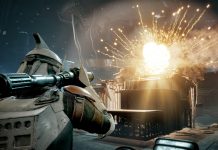
These followers orbit your main character, don’t take damage, and allow you to do some wild stuff. In the 40,000 universe, there’s a character that’s literally just a dude in a massive tank, complete with a huge sprite that takes up about a quarter of the screen. When you collide with an enemy, it does massive damage and runs it over. He’s not very fun to play as, mainly because his cannon is a limiting weapon, but I do like having him as a follower because he still crushes fodder enemies with ease, even putting huge dents in early bosses and elite creatures.

Speaking of which, you’re treated to battling three separate factions of foes in each universe. 40,000 has Tyranids, Orks, and Nurgle’s Death Guard Space Marines, while Age of Sigmar utilizes Skaven, Blades of Khorne, and Gloomspite Gitz. The differences are scant – they all try to run into you and kill you – but the designs are lovingly detailed, ranging from borderline cute to grotesque. Each run ends with massive Extremis bosses, but you need a specific weapon evolution to fight and defeat them; otherwise, they kill you fast, as the reapers did in Vampire Survivors. I didn’t really like that requirement, but beating these bosses was satisfying once you met the parameters.
True to Warhammer‘s complicated RPG roots, you’ll now find status effects like Stasis, Poison, Frenzied, and Instant Kill (you can guess what that one does), and you’ll encounter them differently from faction to faction. Your weapons are imbued with elements and statuses as well. Fire weapons can burn, lightning weapons shock, etc. You know, RPG stuff. Vampire Survivors didn’t really have these dynamics on this scale, so this is a welcome expansion on the formula, especially given the context of Warhammer.
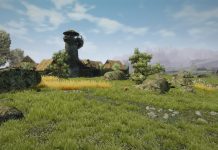
The maps are fun and much more varied than I’m used to in these games. Not only do we get two totally tonally disparate universes to explore, but they’re even broad within the same universe. 40,000 puts you on a derelict space hulk ship with eerie halls and plague-like Death Guard enemies to fight, but also a massive post-apocalyptic Ork fort to traverse, or how about vast wastelands to get disemboweled by Tyranids on? Each has their own secrets, too. Age of Sigmar offers a little less diversity overall, but I do enjoy its dark fantasy lands, blushed by lava or flanked by the bottomless pits of the underground, to funnel you into rat hell with lurking Skaven.

More often than not, I felt like I was back in my Vampire Survivors days, sinking hours into run after run, trying to find out how the hell to unlock a character or evolve a weapon into its peak form. The more you do and discover, the more you’re rewarded. Use the money you earn to bank into persistent boosts and buffs in several categories like Wounds (the game’s term for health), faster weapon reload, or pickup range, just to name a few. One thing I didn’t like was that if you buy one upgrade, the price for all the others goes up, not just the one you bought. Vampire Survivors did this too, but I didn’t really like it there either. It makes some progress start to feel unattainable after a while, until you really start raking in the money regularly, which doesn’t start happening until you crack the game’s shell and reach a flow state after hours and hours of effort.
Persistent as I am, it took over 20 hours to really dig into the game’s meat and push past its 50% completion threshold. That’s a big ask for most people – hell, it’s a big ask for me. The journey is fun enough, clearly, as I didn’t drop the game or give up, and I didn’t feel I had to force myself to push forward, but it’s still a lot. I think back to Vampire Survivors, which also took some time to fully click, flood the game with unlocks, and show its potential, but not quite this long.
Warhammer Survivors splits progress into two halves with almost no overlap, which makes it even worse, since you have to put considerable time into both Age of Sigmar and 40,000 to feel something in either. Again, it’s a lot. If you’re a Warhammer diehard, which I am not, you’re probably fine with that. I am, I guess, a bit of a roguelike and Survivors diehard, so I was okay with it from this angle, but not overly thrilled. Catching a more casual audience on either side, though, is a tall order.

There are several ways the game could and should have made progress overlap between universes. For instance, a few weapons appear in both, like the aforementioned Nuln Oil and D6 Dice. If you evolve either of those, credit for that could reflect on both sides of Warhammer Survivors when it comes to ticking off the checkboxes for evolved weapons. The Celestial Arcana and Emperor’s Tarot cards that grant big, run-altering effects are mostly the same on each side – unlocking a tarot card in 40,000 should unlock the equal arcana in Age of Sigmar. Little things that foster shared progression like this would go a long way toward eroding the grind and making it more palatable as a fun time sink that still respects the time you put into it.
There’s also just so much stuff to see, unlock, and conquer. You start with fewer than 30 objectives, but over time it balloons into the hundreds, creating satisfying yet imposing mission creep. Times it by two – each universe has its own objectives – and you start to see where my elation with the game starts to butt heads with the frustrations I have. You can also unlock map modifiers like ‘Heavy Metal that increases the move speed for you and enemies, among other player bonuses, or the game-breaking Limitless mode that makes it so your character can still level up and grow when all weapons are maxed out. Once you get that, it’s like hitting 88 miles per hour in a DeLorean – you’re about to see some serious shit.
So while I did overall like and even often love my time with Warhammer Survivors, and the motivation to keep playing in my downtime hasn’t yet left, its scale is daunting, and the opportunity to streamline a lot of its experience was missed. It currently sits at a “mixed” rating on Steam, and it’s easy to see why: people are running up to its walls and tapping out. Along with some technical issues like the button glyphs for menuing disappearing often and randomly, it’s clear there are some kinks to work out. Also, come on, do we really need to see the pause button in the top-right corner of the screen on console? Auroch just released a roadmap that promises even more content, including quality-of-life and balance changes, in January 2027, so here’s hoping they address the under-the-hood stuff as much as the content itself, because as much as there is already, it will eventually run out.

Warhammer Survivors was perhaps overly concerned with packing as much Warhammer as it could into the game and not quite enough with how it can all synergize better. It feels silly to complain about breadth of content when so many games can come up light on it these days, but damn, I am choking on it all. At least it tastes good, though. The poncle method, by way of Auroch Digital’s work, proves to still be one of the best ways to kill time in the roguelike realm. Just beware the demand it takes to feel accomplished, see it all or even most of it, and realize the fun it holds deep within.

Story via Smashpad. Read the original article