
















_2-218x150.jpg "Make The Call: Football Manager 27 is live across platforms")




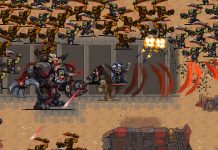
Given how much Ashes of the Singularity draws from the excellent Supreme Commander, it’s fitting that the sequel made me think of Supreme Commander 2. In a bid to make itself easier to get into, that game simplified its economy and shrank its battlefields, losing a lot of the scale I loved about the original. Ashes of the Singularity 2 still has room for thousands of units and several fights raging across enormous maps. It’s just made it a hell of a lot easier to keep track of the war, and thus manages to do what Supreme Commander 2 couldn’t.

REVIEW AT A GLANCE

Developer Oxide Games

Publisher Stardock Entertainment

Reviewed On PC

Available On PC

Release Date 10 November, 2026

Price (UK)

Genre RTS

Review Code Provided by the publisher
Quick Take:
Ashes II makes it easier to keep multiple fronts going without forgetting your factories, research and expansion. The campaign’s forgettable and the regular units could use more character, but cutting the power to half an enemy’s territory before unleashing an experimental mobile factory/tank is the sort of thing that makes me want to fire up another skirmish.
How you feel about that is going to depend on what you hold near and dear about real-time strategy. Being quick with the mouse still helps, especially when you’ve got to jump across the map, make a decision about new buildings and get back to the fight you were already in. Ashes II just makes that easier to keep up with, and if you’re already good at it, you can get on with it that much faster. But you might still miss the micromanagement, hence, there’s a chance Ashes II could be divisive amongst the RTS hardcore. To me, that’s usually the paperwork getting in the way of shit going boom. Shit indeed went boom. And often, sideways.
I love the RTS genre, but I generally suck at it. I’ve been playing since the days of Command & Conquer and Total Annihilation, through Supreme Commander, Dawn of War, Company of Heroes and plenty more besides. All those years of experience have done very little for my ability to remember that I’m supposed to be building reinforcements while I’m watching the front line. I’ll get so caught up moving troops and watching things explode that by the time the fight ends, I’ve got bugger all left and nothing on the way. Meanwhile, the other guy remembered he owned factories and has still been churning things out while simultaneously managing an empire and sending units off on flanking expeditions.
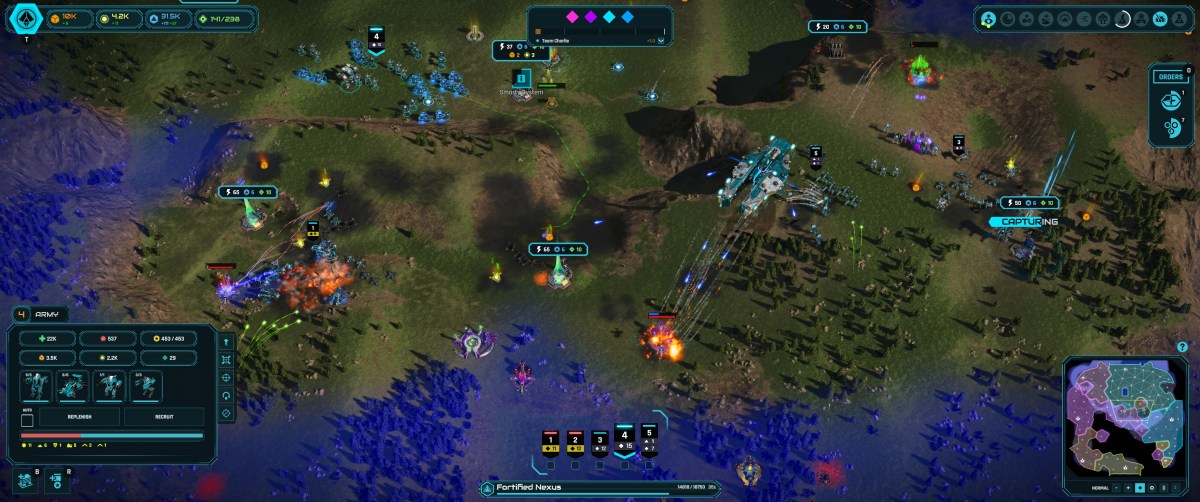
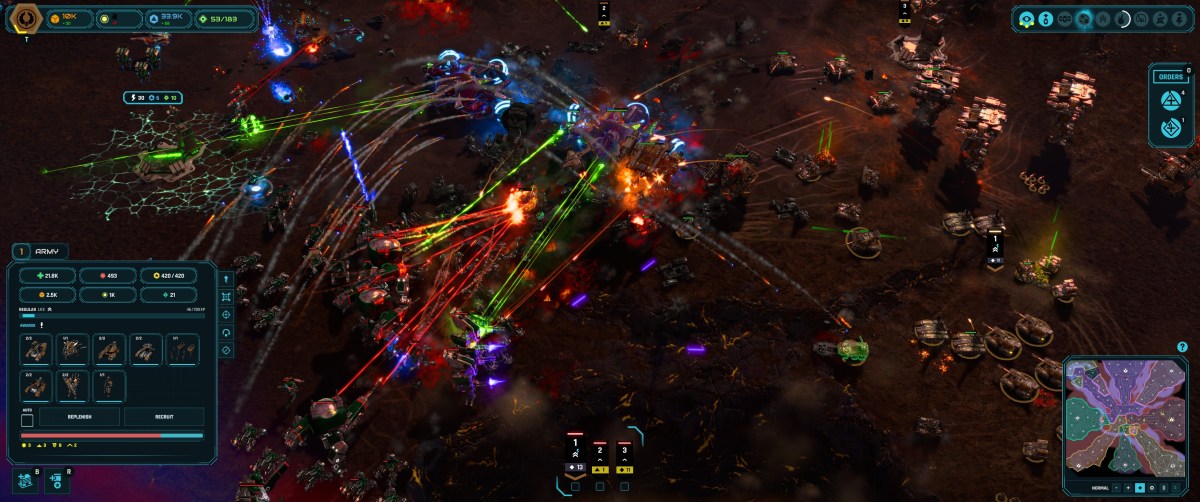
The first Ashes game already let you organise units into armies. I only spent a couple of hours with it about a decade ago, but the change I appreciate here is how much of the work of building and maintaining those armies happens in one place. The create army button is always on screen. It opens a menu of everything you can currently build, so you can put together a force of long-range artillery with a bit of anti-air cover, choose where it should assemble and get back to the fighting without ever moving the camera from the frontline. The game gives the army a number and puts it along the bottom of the screen for quick selection. Select that number and the whole lot will move and fight together. You can still tell a single unit what to do, although the next order to the army overrides it. You quickly figure out the system: some big frontline armies, and then smaller, specialised forces that you support them with.
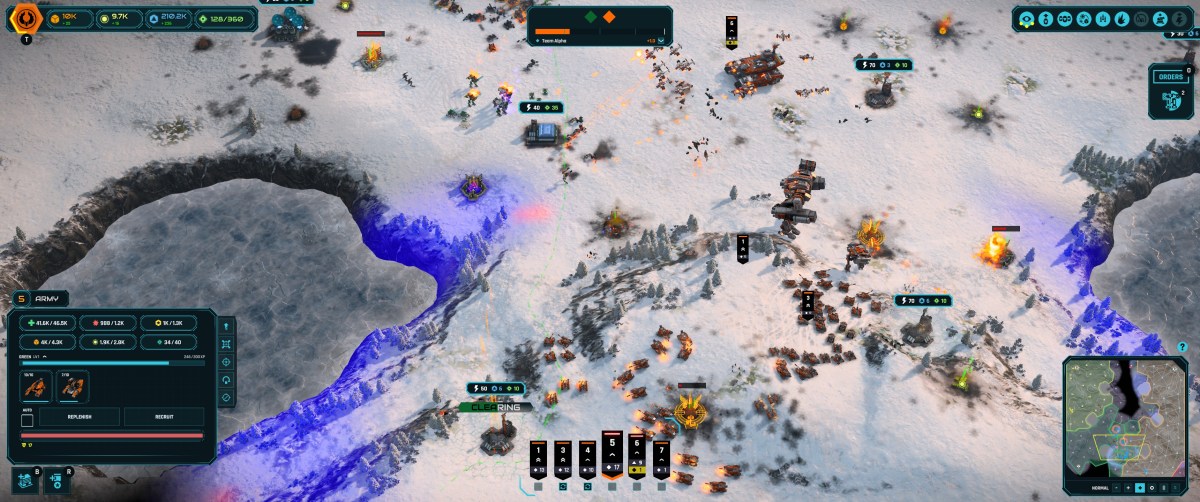
Factories of the same type contribute to production together, and each unit comes out of the appropriate factory closest to where it’s needed automatically. When I moved an army from one region to another, I watched its orders switch to the factory nearer its new position. You can recruit straight into an existing army or set it to automatically replace losses, although doing that risks overloading your economy The interface could explain the system better. The progress circle above the factory made it look like that building was doing all the work. I also couldn’t find a way to pick the factory myself. If I know I’m about to send an army up the map, I’d sometimes rather have its reinforcements come from a factory ahead of it so they can meet along the way, but there’s no way to override the system.
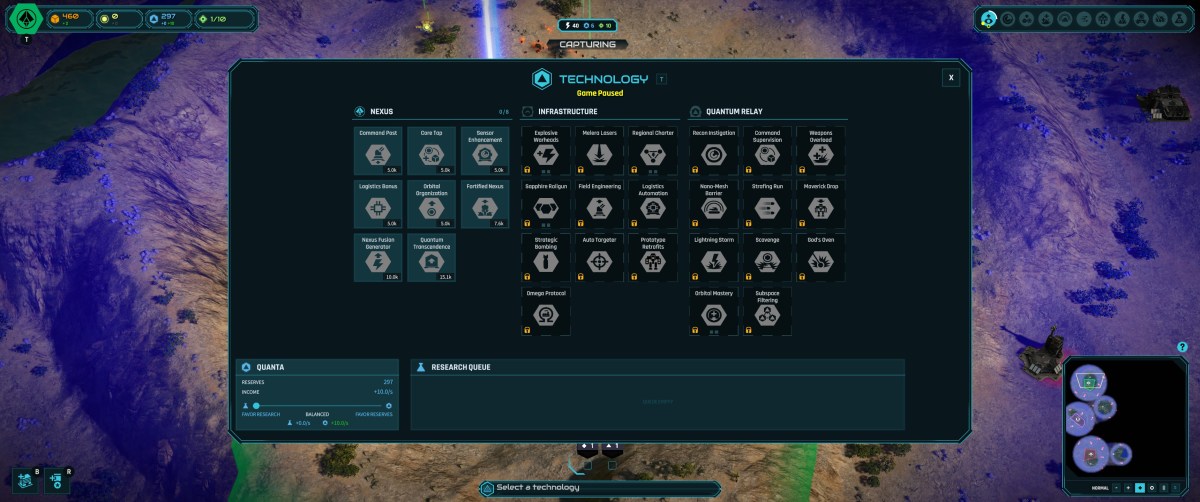
The same idea applies to construction. Regions (more on those soon) have their own construction bots, so putting down a turret doesn’t start with trying to remember where you left your bloody engineers. A region can only handle so much building at once, and the economy still works much like Total Annihilation or Supreme Commander. You spend resources as construction progresses, so between new buildings, fresh armies and automatic replacements, it’s entirely possible to ask your economy for more than it can supply and watch production slow to a crawl.
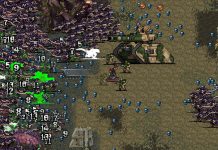
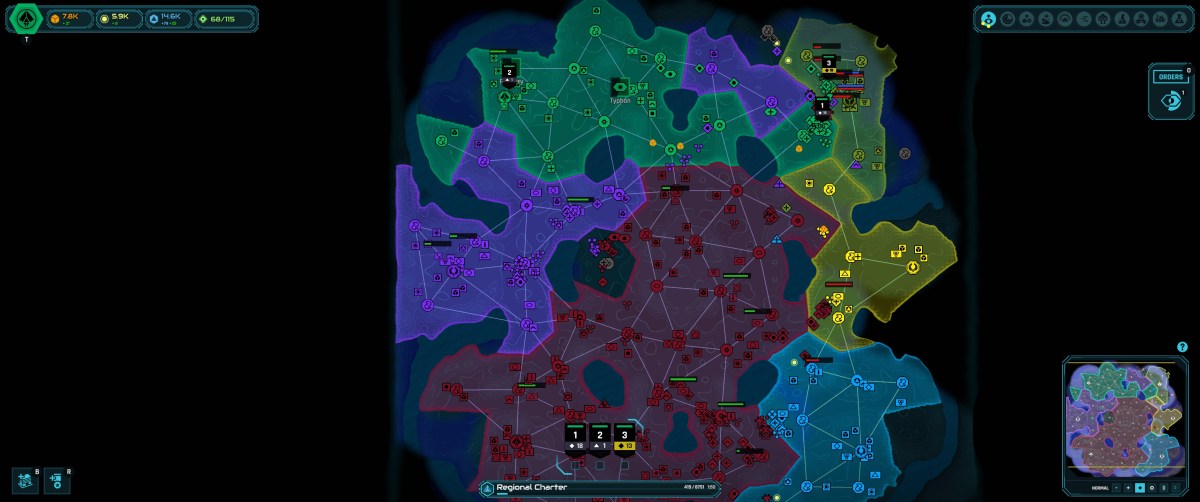
All of this streamlining gives me more time to think about where those big stompy robots should go. The strategic zoom is straight out of the Supreme Commander playbook. Pull back and the regions become colour-coded, with armies reduced to dots you can track across several fronts. From this bird’s-eye view, I felt like a god of war, except with fewer anger issues and a better suntan. Zoom back in, and you can deal with the details that matter, like getting artillery onto higher ground, flanking a new enemy force that has entered the fray or positioning yourself for an ambush. Terrain plays an important role, both for cover and just getting better sight lines.
The numbering system gets a little muddled once armies start merging or getting wiped out, mind you. When I’ve got armies 1, 2, 6 and 11 running around, I’d love to be able to call one of them “Artillery” or even stick a little icon on it so I know which one I want at a glance. Maybe my memory is just going, but sometimes I forget which number is supposed to do what.
The game tends to push you towards taking and holding territory. Capturing a region by taking its relay gives you new deposits to mine and raises your Logistics cap, which governs how many units you can field. Buildings and research can increase that capacity further. To keep a region powered, though, you need a chain of friendly territory linking it back to your Nexus. In one campaign mission, I carved a line through enemy territory and watched a huge chunk of it go dark. The enemy units were still there, but the buildings and defences shut down, and my other armies were able to walk in and capture the ground with ease. I like this system, as it encourages actual thought regarding supply lines.
Different regions also offer different bonuses. By default, each region’s relay is also guarded by a small force of neutral enemies which slows down initial land-grab strategies, although you can turn these off in skirmish mode. Most regions are power relays, but others might be a research facility that boosts your research point gain; another might open up some new units to build and so on.
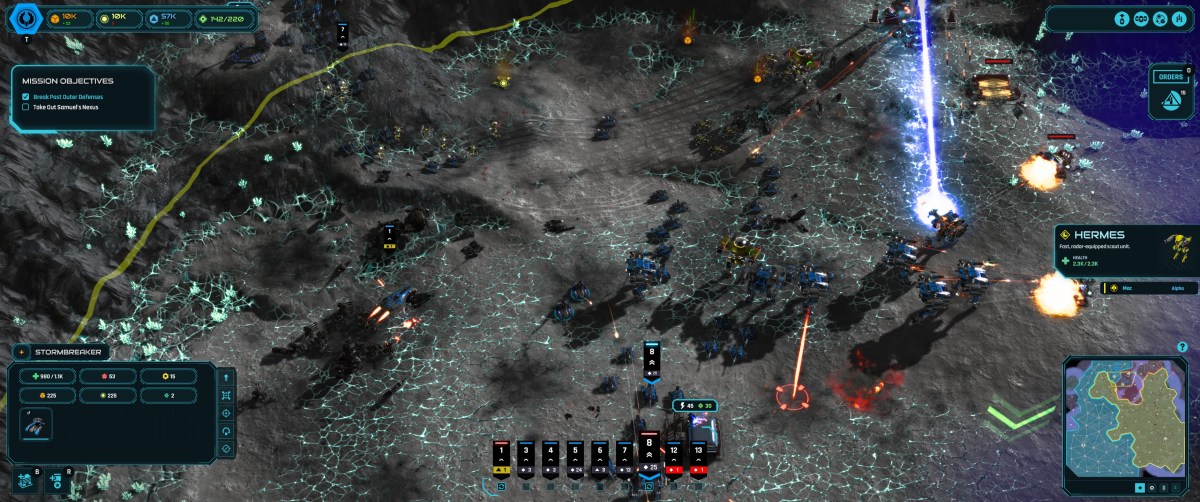
I’m less taken with the units themselves. The United Earth Forces have straightforward, tiered research and the chunky military hardware I’m most drawn to. The Post-Human Coalition made me stop and pick a SubCommander when creating each army, and the Substrate’s regenerating shields, swarms of drones and web of research were the differences I noticed most. Even so, I fell into much the same habits with all three. Each side has its answer to tanks, artillery and aircraft, and most of the ordinary units are easy to think of purely in terms of the job they do. Part of that comes from spending so much time zoomed out, but I can still remember individual machines from Total Annihilation that had more character.
The experimentals are where I start getting excited about what’s coming out of the factories. They’re the machines that make me want to zoom in and watch what happens when I point them at something. Massive stomping mechs, rolling factories, flying motherships that launch drone swarms, experimental artillery that can batter enemies across the map – they are all fun to unlock and play with.
With the UEF I could get to those unlocks fairly quickly by prioritising research, though the size of the map and how aggressively you play do a lot to determine how long a match lasts. Experimentals are powerful, so I was worried rushing straight to those would become the de facto method of play, exactly what happened with Supreme Commander 2. But that isn’t the case. I like the balance here. A battle has room to develop without necessarily eating the rest of my evening or become a week-long match. They can be over fast if smart decisions are made and the enemy tries to advance too quickly. Likewise, matches can become a slugfest of two economic powers clashing.
The orbital abilities are good fun too. Dropping emergency troops or a turret, or calling in a bombardment at the right moment, can give an army the help it needs without doing the whole job for you. I’d say most matches will last up to an hour or two, but it’s hard to say since it depends on how skilled players are and their respective strategies.
The campaign follows the United Earth Forces as they fight to reclaim territory from the Post-Human Coalition. The post-humans are people who’ve uploaded their minds and become digitised beings, and their existence depends on Turinium, a manufactured material that gives them computing power. A post-human has begun converting the surface of the Moon into the stuff, and nations on Earth pool their forces to begin pushing back. There’s a decent science-fiction premise in there about how much of yourself you can change and still call yourself human. Its well-trod ground, to be fair, but still fun. And you can get the gist without having played the first game.
The missions do a perfectly serviceable job of introducing the mechanics and giving you a place to practise them. I just couldn’t bring myself to care about the story. Most of what I remember of its delivery is people talking over the radio, with the odd slow pan across a battlefield or a mostly static screen. The dialogue is clunky, and the performances rarely give it the urgency you’d expect from people fighting over the future of humanity. Half the time these people sound like they’re in charge of the local Starbucks as it plans a campaign against Costa Coffee, rather than making military decisions on behalf of the Earth or leading massive armies. I was much happier once the talking stopped and I could get on with the mission.
Skirmish is where I’d expect to spend most of my time. The game ships with 16 hand-built maps and a generator for when you want a fresh one. I generally preferred the presets, but the maps I generated played well and their layouts made sense, so it’s a neat way of getting more value out of the game. You can set up teams and starting resources, adjust the speed and toggle the neutral defenders that guard capture points. Taking out the enemy Nexus is the direct route to victory, but there are two other game modes as well. I found the AI a solid opponent on easy and medium, where I spent most of my time. My occasional trips into the harder settings are about as far as my expertise extends – I occasionally held my own, but mostly got stomped. There’s also three even higher settings that deliberately give the AI economic boosts to make it even harder.
Online matches support up to eight players, and you can team up with friends against the AI or go up against the sort of person who’ll hand you your arse while telling you what they did to your mother. I didn’t run into connectivity problems in my prelaunch games, though I had a limited pool of people to play against. As such, I don’t want to go on record as definitely saying the multiplayer was flawless – if I get time to check it out further, I’ll update this review, but check out the Steam discussions for a better idea of whether there are any issues.
The game ran extremely well for me, even with battles going on across the map. This is a good-looking game, especially when you zoom into the action and watch the mayhem, and the sound effects do a good job of selling the combat. I was playing on an older Ryzen 5 3600 combined with a RTX 5070 and 32GB of RAM and had everything on high on an ultrawide and a 60fps cap. It ran perfectly. That said, the game allows for thousands of on-screen units, so performance may have dipped if I had managed to get 8 people producing the biggest armies possible.
In Conclusion…
I can see why someone who enjoys squeezing everything out of six factory queues might miss doing it themselves. For me, the best part of a big RTS is looking at the map, spotting a way through and seeing whether I can pull it off. I can send one army to keep the enemy busy and another to cut the power to half a player’s regions, but I still have to judge when to make the move, jump between both fights as things change and make sure I can afford to replace what I lose. Having the factories handle the deliveries makes it a hell of a lot easier for me to keep up. I wish the campaign had given me more reason to care and more of the units stuck in my head afterwards, but I can remember what I did with those armies, and I’m already thinking about what I’d try in the next match.
Basically, Ashes II lets me focus on the parts of the genre I love, and handle the bits I don’t far more easily. For some people, that streamlining might kill what they love most. For me, it lets me love it more.

Story via Wolfsgamingblog. Read the original article