













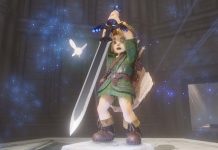









I’ll not spend too much time on the story here because frankly you probably already know it, and even if you’ve never played the game before, there’s not a whole lot to it. The story follows Link, a child who grew up in a forest on the outskirts of Hyrule under the protection of the forest’s guardian, the Great Deku Tree. With the Great Deku Tree sensing he’s not too long for this world, he summons Link to defeat the blight within him, and following that, sets him off on his larger quest to save the kingdom from a looming evil threat. On his journey he’ll meet a small assortment of interesting characters, help people out day to day tasks, and ultimately, save the kingdom. But we’re getting ahead of ourselves.
The game opens in Kokiri Forest with a very familiar, albeit now fully voice acted, cutscene, introducing us to a small snippet of the refreshed world. There’s a real wow factor to it that I can only imagine is how many felt seeing the Zelda series move to 3D for the first time. The new style jumps out as much as the increased scale of the world. It all feels somewhat fantastical, with the art direction feeling more like a Disney puppet show than anything I’ve seen from the Zelda series prior. It’s great, but it is very different; it certainly took me a moment to realise I liked it.
Despite the forest now being larger with new things to see scattered about, the core objectives of the intro remain untouched. You still need to get the sword, you still need to collect 40 rupees, and you still need to immediately spend that on a shield. Through these small tasks the game seamlessly puts in front of you some of its most significant changes, these being how you control Link. We have more buttons nowadays after all, Nintendo had to find a way to use them.
In short, the game follows a lot of the norms set out between Breath of the Wild and Tears of the Kingdom. You jump with X, swing your Sword with Y, and you can move your camera with the right stick. Moving your camera is surprisingly a notable feature here, with this being the first time Ocarina of Time has officially had support for such a thing. Moving away from the modern releases though, Link’s iconic roll is kept on the A button, with holding it now allowing him to break out into a sprint—no stamina limitations in sight on this one—and the B button is used solely to put away what you’re currently holding. It all works pretty well. Out of everything on show here, perhaps the only controversial aspect will be item usage. Where you had three buttons in the original release and four in the 3DS remaster, you’re downgraded here all the way to one. Kind of.
Though you only have one button for items, ZR, many of the things you would want to swap on and off quickly now have a permanent place on the D-Pad. This lets you toggle masks or the Lenses of Truth and your boots of choice, as well as giving you easy access to the ocarina and Navi’s hints where available. I do think the latter of those is a bit of a wasted button, but I will admit I made use of it for some smaller knowledge checks here and there. To this day I had no idea Poes only reappeared when you weren’t looking at them; maybe that’s new to this release though.
The remaining items require you to navigate through an item strip you can access quickly by holding the L or R buttons. You can also swap items out by pausing the game and going through a more traditional item screen. I really thought the one item limitation would frustrate me more, but with how many items have been moved to other areas, the single strip worked surprisingly well in a pinch. I dare say something akin to Twilight Princess or Skyward Sword’s radial menu might have been a better fit, but I never found myself frustrated with how things were setup. Most dungeons are designed around just one or two of the core items, so it’s rare you’ll be juggling between them.
Pressing on past the various tutorial tidbits and into the first dungeon, you get a really good sense of what the game is going for. It just goes to reiterate what you’ve already seen in the forest to some degree. Bigger, a bit more of a spectacle, with a few new tidbits hidden here and there. And yet still very familiar. If you’ve played any of the previous versions you won’t necessarily get lost, but you will frequently find yourself pointing to the screen shouting about how things are tweaked. The general theme of these changes seems to lean towards making the experience more seamless. Some areas do come across a little more linear for those changes, but ultimately I do think they’re for the better.
Once you’ve bested your first boss you’re let loose on the rest of Hyrule, and boy is there a lot to see out there.
Stepping out into Hyrule Field is supposed to be the game’s big “stop and stare” moment. That’s certainly how I remember it from both the N64 and 3DS releases. You’ve emerged from this cosy and closed off setting into a world that’s ripe for exploration and discovery; of course you’re directed to go towards the castle, but there’s nothing forcing you. This was the moment where I really expected I’d be taking in the new world and hyping myself up for what’s to come. The reality though? You emerge from the forest, the fog fades, and the distant scenery just looks… Flat?
This is by no means a game ruining moment, but much like how Kokiri Forest sets the bar for the smaller and more intricately crafted areas, Hyrule Field does something of the opposite. It’s in these distant shots and moments of the true scale of the world being demonstrated where I really do think this release falls short. It’s a small criticism when put next to the larger game, but it does stand out as the hub connecting these much better looking areas. You do find other moments of ugliness here and there, particularly when the game’s engine is pushing the console’s hardware. One particular fight towards the end of the game has lightning falling down and I very much could count the pixels on each bolt. These moments are few and far between though, with the vast majority of the experience living up to the standards set by its introductory segment.
One area the development team was apparently very intentional on was the placement of loading zones throughout the world, and coming back to this iteration of Hyrule after so many hours of playing the 3DS version, I am left with some questions. Kokiri Forest now leads directly into the Lost Woods Bridge when leaving with no loading screen. The Hyrule Field map now contains both Lake Hylia and Lon Lon Ranch, that’s cool too. But then you have some odd moments like Gerudo Valley and the fortress being separate maps, despite it being a relatively small transition. Kakariko Village and the Graveyard are separate, Zora’s Domain and Fountain. The more open nature of the world feels like a confused half measure, with the supposedly very intentional placement almost feeling random. It’s one area I feel they could’ve pushed a little more, making use of natural corridors to manage loading as opposed to the harsher loading screens. This is something you’ll notice a lot more if you’re coming back to the game versus playing it for the first time though.
Many of the smaller changes seem to the game seem to push on an idea I’ve come to describe as fantasy realism. Yes you still have enemies appearing from purple smoke and the like, but much of the world and physics at play feel significantly more grounded. Enemies take more hits and tend to punish you for just standing there swinging a stick at them. The most notable change in this bracket to me is the removal of in-game timers though. They’re not completely gone mind, you’ll still be racing against the clock to deliver ingredients before they spoil as a part of the late-game trading quest. But the timers for drowning and overheating? Gone. These are replaced by your hearts ticking down instead; a change that does make sense since these timers originally scaled with health. They’re not the only ones to go though, with rooms that previously put you on a timer to collect silver rupees or defeat enemies now significantly more relaxed. My theory here is that whiting out with no in-universe explanation didn’t fit with the world they were building with this release, but the lack of any kind of mechanical replacement is something you notice. It removes stakes from a few areas in the game, with this impacting the optional Gerudo Training Grounds more than anywhere else.
Despite the lack of stakes in the Gerudo Training Grounds, I do think the majority of the changes made to dungeons are positive. Outside of a new crawl space here and there, a good chunk of these involved streamlining tedious segments and opening up areas in a way that makes dungeons feel much more connected than before. Exploring these was a real highlight of the adventure for me, as dungeons undoubtedly should be in a Zelda title. What I touched on earlier in talking about Kokiri Forest holds true here, with the more closed off areas really feeling like they got some fantastic attention to detail.
My least favourite dungeon of Ocarina of Time would almost certainly be Jabu Jabu’s Belly, and though the remake did little to change the core of the experience, it really went a long way in making it feel like somewhere I wanted to explore. The lighting, the floor bouncing as I walked over it. It felt alive in a way I didn’t think it ever could. These small moments are littered throughout the game’s eight dungeons, changing enough to keep the experience fresh for the old guard, while maintaining much of the same spirit they previously loved the game for.
This all comes to a head with the game’s finale, which I obviously won’t be spoiling in great detail here. What I will say is that it’s a much more cinematic conclusion to the game than was previously possible on the N64, culminating in both a final fight and ending sequence that ended up being the highlight of the game for me. And I say that as somebody who would almost always just skip the final fight when replaying the original release.
There is naturally more to do in Ocarina of Time than follow the beaten path, with a few small side quests to pick up along the way, and plenty of collectibles to fish out. In total you’re looking at 100 Gold Skulltulas scattered across the world, a bunch of Heart Pieces to discover, shooting and fishing minigames, and a few other pieces scattered here and there. For the most part you’re free to engage with these as you want. You can rush them as soon as you’re able, or you can put them off or avoid them entirely if that’s more your pace.
One area that has been improved on though is in making these quests more accessible, particularly in hunting for Gold Skulltulas and figuring out which Heart Pieces you might have overlooked on your journey. For helping you find Gold Skulltulas, a new optional pin is available. When you’re near where one should spawn, it’ll glow on the UI to let you know. I quite liked this as somebody who likes to clear everything they can as they go, and I also enjoyed that I still did have to put a little effort in to figure out where exactly they were crawling around. Though a lot of these crafty things are where they were 18 years ago, some have been shuffled. You can’t rely purely on your muscle memory.
Supporting this pin is the game’s map, with it showing how many Gold Skulltulas and Heart Pieces you have in a given area, as well as the total available to you. I admittedly only noticed this after 100%ing the game, but I can certainly see how it would be handy for those of you sitting on 19 Heart Containers, wondering where you forgot something. If you’re wanting a little more direction, the Zelda Notes app does act like the game guides of old for Nintendo Switch Online subscribers.
You do have other changes in the world that does line up with this larger idea of accessibility. Hidden grottos are now a thing of the past, with both those accessible via bombs and the Song of Storms marked in their own way. Pierre the scarecrow does also benefit from these changes, with areas you can summon him now marked with swirling leaves. I personally like these changes, though I’m sure there are some folks out there longing for the return of the Stone of Agony.
As it stands, this release of Ocarina of Time is somewhat limited in its replayability. You get one save file and no additional modes to explore once you beat the game. No Master Quest, no Hero Mode. According to my Play Activity stats, it took me a grand total of 15 hours to do everything there is to do in the game, getting 100% of the collectables and saving the kingdom. I do think I’m something of an outlier here with how many hundreds of hours I’ve spent playing the 3DS version of the game though, with a more regular 100% playthrough likely sitting somewhere between 20 and 30 hours.
If I’m being honest here, I’m left wanting more. Though I did have a stellar time playing through what we do have right now. I am very much expecting some kind of Master Quest to release for the game down the line, be it as a free update or paid DLC. In the previous releases, this not only doubled the damage Link receives from enemies, but also reworked the dungeons in fun and interesting ways. I’d love to see what they do with this world, though there’s obviously no guarantee this will indeed come.
Even if I do want more, it’s hard for me to call this release anything short of fantastic. I’ve no regrets buying it, and I’ve no doubt I will be back later. Whether that’s in the form of me restarting my save or playing additional content though, I’m not sure. The Switch 2 remake is a game that truly thrives in its more intricately crafted areas and moments, bringing the iconic kingdom of Hyrule to an entirely new generation. If you have a Switch 2, it’s not a game you want to miss out on.
Story via Gbatemp. Read the original article